

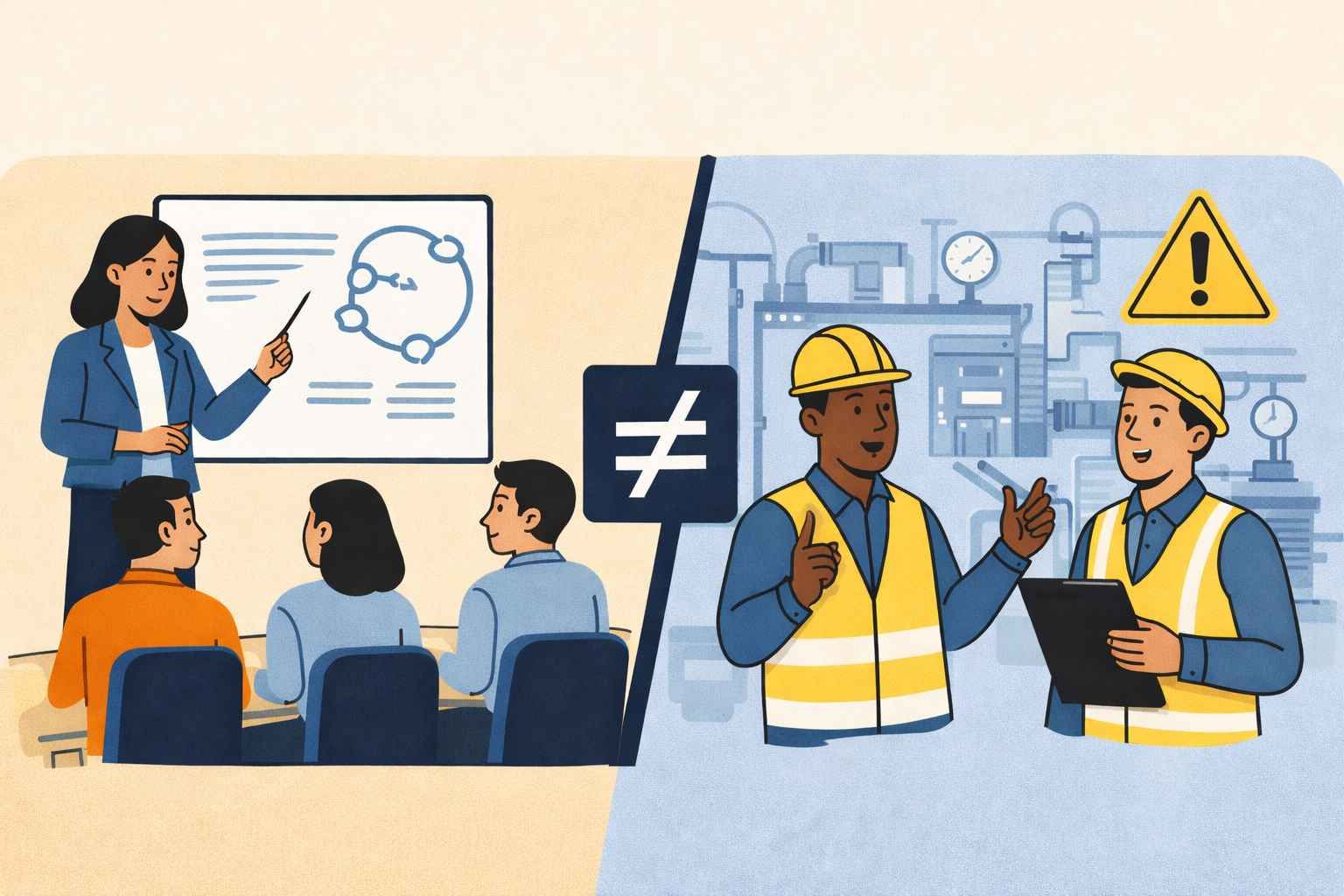
Why Operational Learning Is Not Training?
Training and operational learning are not the same thing. Organisations that have poured significant resources into training and still see recurring performance gaps, persistent workarounds, and safety incidents will recognise that distinction quickly. It is not a theoretical point.
Operational learning vs training is not a comparison of better content or improved delivery. It is a difference in the fundamental assumptions each approach makes about where knowledge comes from, who holds it, and when learning actually occurs.
Training assumes the answers are known and need to be transferred. Operational learning starts from the recognition that the most important knowledge about how work actually runs lives in the direct experience of the people doing it, and needs to be surfaced rather than delivered. Everything else follows from that difference.
The Difference Runs Deeper Than Delivery Method
Training is built around what experts believe workers need to know. Content is designed, packaged, and delivered. The direction is one way, from the system or the instructor toward the learner. Whether workers attended and passed the assessment is typically how success gets measured. The underlying logic is that if the right information reaches the right people, performance will follow.
In environments where tasks are repetitive and conditions change very little, that logic produces reasonable results. Most operational environments are not those environments.
Real work is dynamic. Equipment behaves differently as it ages between maintenance cycles. Teams shift in composition across shifts. Time pressure rises and falls with operational demand. Workers adapt constantly to keep operations running under conditions the training materials could not fully anticipate. These adaptations rarely make it back into any training system. They accumulate in the experience of the people making them, and stay there until something deliberately surfaces them.
Operational learning works in the opposite direction. It draws knowledge out of direct operational experience rather than delivering knowledge toward workers. It starts from what workers already know from direct operational experience, and examines what that knowledge reveals about how the system is actually functioning. That reversal is not a refinement of training. It is a different starting point entirely.
Why Training Struggles in Dynamic Operational Environments
Training materials are built at a point in time based on the conditions planners understood at that point. They reflect the official version of how work should happen. In dynamic operational environments, the official version and the reality it describes diverge constantly.
Procedures assume stable resource availability. Real operations run with varying staffing, equipment in different maintenance states, and time pressures that shift with demand. Training assumes that certain conditions will be present when the trained behaviour is required. Those conditions are often not present.
A worker who completed a refresher course six months ago and is now managing a situation the course did not anticipate is not drawing on their training. They are drawing on experience, informal knowledge from colleagues, and an accumulated understanding of how work actually runs in this environment. That accumulated understanding is not captured anywhere in the training record.
Timing creates a further limitation. Training happens before or after work rather than during it. The gap between the training environment and the operational environment is substantial. Skills and knowledge that transfer well in a controlled setting often look quite different when they encounter real operational conditions. The assumption that completion of training translates to operational capability is one that experienced operators see challenged regularly in practice.
Operational Learning Starts Where Training Stops
Operational learning begins with the recognition that work is complex, variable, and shaped by context. The question it asks is not whether people followed the procedure but what made sense to them at the time, under the conditions they were actually working in.
This shift changes what the organisation is trying to understand. Training asks whether the right information was delivered. Operational learning focuses on a different question: what is actually happening in operations right now, and which conditions are producing those outcomes.
In practice, this means looking at how work unfolds during normal operations rather than only reviewing what went wrong after the fact. It means treating frontline adaptation as data about how the system is functioning rather than as evidence of non-compliance. Workers who develop workarounds are usually compensating for a gap between what the procedure assumes and what operational reality requires.
The operational understanding that results from this kind of examination cannot be built in a classroom. It emerges from structured reflection on real work experience, and the insights it produces are the kind that genuinely change how systems are designed. Training provides a foundation. Operational learning builds the understanding that sits on top of it.
Learning Teams Create the Conversation Training Cannot
Training is typically a one-directional activity. Knowledge moves from the system or the instructor toward the learner. Frontline workers receive information, are assessed on their retention of it, and their direct operational experience does not enter the process.
Operational Learning Teams create the conversation that training cannot.
Sessions bring together frontline workers, supervisors, and a senior sponsor to examine how a specific task, activity, or operational topic actually unfolds in practice. Participants describe their direct experience in full. They talk about what makes the work difficult on this task, the conditions that shaped their decisions under pressure, and the points where the documented process and the operational reality diverge. This is knowledge the training system has never accessed, because it lives in direct operational experience and no formal channel draws it out in this way.
Learning Teams platform captures and preserves what surfaces across sessions. Insights connect across teams and locations. Recurring themes become visible. The organisation builds a continuously updated understanding of its operational reality rather than relying on training materials written when conditions may have looked different. That is a qualitatively different kind of organisational knowledge, and it is one that training alone cannot produce.
How the Two Approaches Compare
The philosophical differences between training and operational learning run across every dimension of how learning is understood, structured, and applied. The table below captures the most significant of those differences.
| Dimension | Training | Operational Learning |
|---|---|---|
| Core Assumption | Work is stable and procedures reflect reality | Work is dynamic and reality shapes how procedures are followed |
| Starting Question | What do people need to know? | What do people already know from direct experience? |
| Direction of Knowledge | From expert or system toward the worker | From worker experience toward the organisation |
| Response to Incidents | Retrain the individuals involved | Examine the system conditions that shaped the outcome |
| Cultural Effect | Compliance becomes the measure of performance | Curiosity replaces blame as the default response to problems |
| How Improvement Happens | Updating procedures and delivering revised content | Changing system conditions based on operational insight |
| Relationship to Experience | Worker experience is assessed against content | Worker experience is the primary source of operational knowledge |
Why More Training Rarely Fixes Recurring Operational Problems
Recurring safety incidents, productivity gaps, and performance inconsistencies tend to produce the same organisational response: more training. The reasoning is understandable. When capability appears to be falling short and training is the primary mechanism for building it, additional training feels like the logical next move.
The problem is that training addresses knowledge at the individual level. It cannot change the system conditions that shape what individuals do under operational pressure. When a procedure is unrealistic for the conditions workers actually face, retraining the worker who navigated around it does not make the procedure more realistic. When a coordination gap between two departments produces recurring delays, retraining individuals in each department does not close the gap.
Recurring operational problems are almost always systemic. They persist because the underlying condition that makes them predictable has not been examined or addressed. Operational Learning Teams examine those conditions directly. They surface the procedural gaps, resource misalignments, and coordination weaknesses that training cannot reach, in a setting where the people with authority to act on them are present in the room.
Organisations that understand this distinction stop adding training as the default response to performance problems and start examining the systems in which performance happens. The improvement that results is more durable, because it addresses what is actually creating the problem rather than the individuals working within the conditions the problem creates.
Conclusion
Training has a genuine role in any organisation. It builds baseline competence, meets regulatory requirements, and supports onboarding. These are legitimate functions that course-based systems handle effectively.
But training was never designed to do what operational learning does. It cannot surface the knowledge that experienced workers have developed through years of direct operational experience. It cannot examine the system conditions shaping performance right now. Nor can it create the shared understanding between frontline workers and leadership that grounds improvement decisions in operational reality rather than documented assumptions.
Operational learning vs training is not a debate about which approach is superior. It is a question of which questions each one is built to answer. Training answers the question of baseline competence. Operational learning answers the question of how work is actually happening and what the organisation can do to improve it.
FAQ’s
Is operational learning designed to replace training?
No. Operational learning complements training rather than replacing it. Training builds baseline competence and satisfies regulatory requirements. Operational learning surfaces the knowledge that training cannot access, examines the system conditions shaping performance, and generates the operational understanding that drives sustained improvement. The two work best alongside each other.
Why doesn't more training fix recurring operational problems?
Because recurring problems are almost always systemic rather than individual. Training addresses whether people know what they are supposed to do. Recurring problems usually exist because the system conditions shaping what people actually do under operational pressure have not been examined or addressed. Operational Learning Teams examine those conditions directly rather than adding further instruction on top of them.
How do Learning Teams create knowledge that training cannot?
Operational Learning Team sessions draw knowledge out of direct operational experience rather than delivering content toward workers. Frontline workers describe how work actually unfolds under real conditions, what makes it difficult, and what helps it go well. This produces operational insight that training systems cannot access, because it lives in the accumulated experience of the people doing the work rather than in any content library or procedure document.
Learning Doesn’t Stop Here
Browse our collection of articles on learning teams, operational insight, and improving work as it’s done.


