

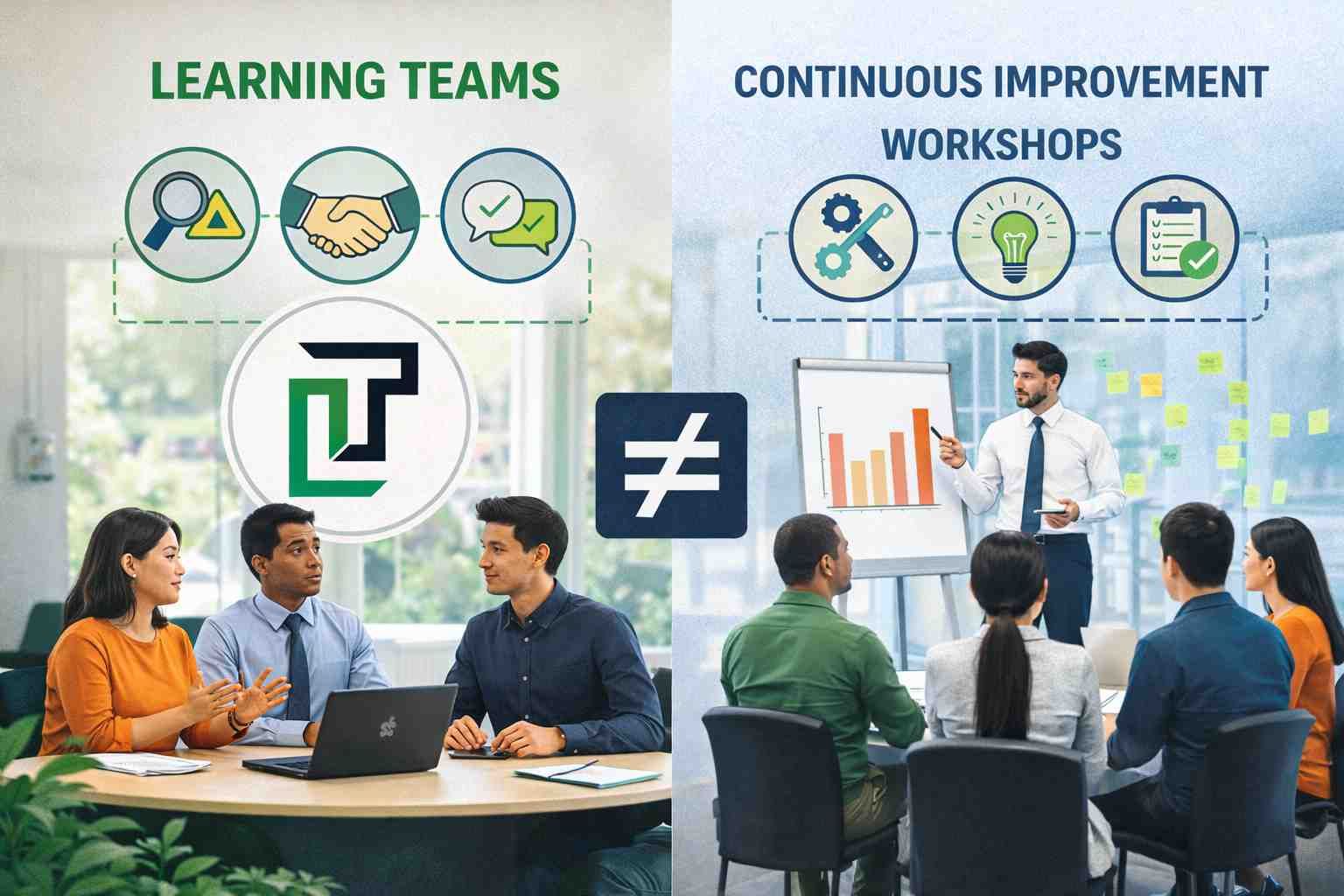
Learning Teams vs Continuous Improvement Workshops: What’s the Difference
Continuous improvement workshops have been a standard part of operational improvement in various industries for decades. Whether they take the form of Kaizen events, Lean workshops, or structured problem-solving sessions, their formats may vary, but their basic approach remains largely the same: a clear problem, a facilitated discussion, a set of improvement actions, and a plan for implementing those actions.
The results are often visible in the short term. A process gets streamlined. A bottleneck gets addressed. Metrics improve for a period. And then, with some regularity, the gains erode. The same issues reappear in different areas. Processes drift back. The next round of improvement sessions starts from a position that looks discouragingly familiar.
Learning teams vs continuous improvement workshops is not a question of which approach is right and which is wrong. Workshops have genuine value in the right context. The more useful question is what each approach is structurally built to do, and where each one consistently runs out of road.
Continuous Improvement Workshops Are Built Around Events
A workshop is an event. It has a start date, a facilitator, a problem statement, and an expected output. Teams come together for a defined period, work through an improvement process, and produce action plans before dispersing back to operations.
The event structure has real strengths. It creates focused attention on a specific problem at a specific time. It produces visible outputs and a sense of shared momentum.
The limitation is also structural. Events end. The knowledge generated in a workshop typically lives in session notes, action trackers, and the memories of participants. When participants move to different roles, when operational conditions shift, or when the problem the workshop addresses morphs into a related challenge, that knowledge does not automatically transfer or adapt. There is no mechanism built into the workshop model for detecting that misfit and adjusting.
Learning Teams operate differently. Rather than generating learning at a scheduled point in time, the platform creates a continuous mechanism for learning from real work. Sessions examine how work is actually running right now, under current conditions, with the people currently doing it. There is no reset between events because there are no discrete events — only an ongoing cycle of examination, reflection, and improvement.
One generates a learning artefact. The other builds a learning system. That is the most fundamental distinction in any comparison of the two approaches.
Why Workshop Improvements Often Fail to Hold
The post-workshop erosion problem has a structural explanation that is worth taking seriously.
Workshops examine a problem as it exists at the time of the workshop, under the conditions present in the room, as described by the people who attend. Improvements get calibrated to that understanding. When conditions change, new equipment, evolving team composition, shifting organisational pressures, the improvement designed in the workshop may no longer fit. But there is no built-in mechanism for detecting that misfit and adapting. The next scheduled workshop may be months away.
There is also the knowledge transfer problem. What experienced workers know about how a specific process runs under variable conditions is considerably more detailed than what surfaces in a workshop discussion. Informal practices, equipment quirks, and coordination patterns that developed outside formal procedure are present in the work environment but rarely in the workshop room. Improvements designed without that knowledge are optimised for a version of the process that does not quite match the operational reality they are being applied to.
Operational Learning Teams address both gaps. Sessions examine how work actually runs under current conditions rather than working from a reconstruction of it. The Soak phase allows the operational texture that does not surface in the initial conversation to emerge before improvement decisions are made. The Improve and Action phase adjusts based on actual operational knowledge rather than documented assumptions about it.
Learning Depth Is Where the Real Difference Lies
Continuous improvement workshops are typically framed around problem identification. What is the problem? What is causing it? What needs to change? These are useful questions. They orient attention toward a specific gap and generate specific improvement actions.
The limitation is that this framing starts from an assumed problem and works backward toward its causes. The picture of operational reality it produces is selective — shaped by whatever problem definition was brought into the workshop rather than by an open examination of how work actually functions.
Operational Learning Team sessions begin with direct operational experience. Participants describe how a specific task or topic actually unfolded. The facilitator explores what conditions shaped that experience, what pressures influenced decisions, and where the system created difficulty.
This produces a qualitatively different kind of insight. An operational challenge that looks from a distance like a compliance issue may reveal itself through direct operational examination as a procedure design problem. A safety incident pattern that looks like a training gap may reflect a coordination structure that consistently puts workers in difficult positions. The depth of understanding this produces is what makes Learning Teams more effective for complex, variable operational environments. Workshops answer the question the organisation thought to ask. Operational learning examines the work and surfaces the more important question.
Frontline Expertise Drives the Process, Not the Tools
Continuous improvement workshops rely heavily on improvement tools: process maps, fishbone diagrams, value stream analysis, root cause frameworks. These tools organise information and structure problem-solving. They are useful for what they do.
But they also have a consistent tendency to shape how operational problems get described. When the primary means of examining a problem is a process map, operational reality gets translated into the terms a process map can represent. Informal practices, contextual variations, and the accumulated experiential knowledge of the people doing the work often do not translate cleanly into those terms.
Operational Learning Teams place frontline expertise at the centre of the examination rather than in the service of a tool. The primary source of insight is the direct operational experience of workers who do the relevant work every day. The facilitator draws that experience out through structured conversation rather than guiding it toward a predetermined analytical framework.
An experienced worker describing how a specific task actually runs provides information that no process map captures: the informal sequence adjustments made under time pressure, the equipment behaviours requiring specific handling not mentioned in any procedure, the coordination patterns two teams developed to manage a gap neither formally acknowledged. This is the raw material for improvement that genuinely fits how work functions.
Learning Teams Software captures what surfaces in these conversations through Centralised Organisational Learning and connects insights across sessions, teams, and locations. The knowledge does not stay confined to a single conversation. Patterns that would be invisible at the individual session level become visible across the organisation over time.
What is the difference between learning teams and continuous improvement workshops
The differences between learning teams and continuous improvement workshops run across every dimension of how each approach generates and applies knowledge.
| Dimension | Continuous Improvement Workshops | Learning Teams |
|---|---|---|
| Nature | Event-based | Continuous learning system |
| Starting Point | Defined problem | Direct operational experience |
| Learning Depth | Often surface-level | System-level, contextual |
| Frontline Role | Participants in a session | Primary source of operational knowledge |
| Sustainability | Often erodes as conditions change | Adapts continuously with operations |
| Knowledge Storage | Session notes, action trackers | Centralised, searchable, connected over time |
| Facilitator Dependency | High | Reduced through built-in platform structure |
| Outcome | Improvement actions | Ongoing operational understanding |
From Workshops to Operational Learning
Continuous improvement workshops are really useful in specific situations. Introducing a team to improve concepts, building consensus on a common goal, or applying a structured tool to a specific and technical problem are situations where the workshop format works effectively.
The situations where workshops are consistently less effective are those where operational complexity is high, conditions change frequently, and there is practical knowledge gained from years of experience that formal improvement tools are not designed to access. In such environments, the event-based structure and the absence of a continuous learning mechanism combine to limit how much real operational understanding a workshop can generate and how long the improvements it achieves can be sustained.
Operational learning does not replace workshops. A workshop can introduce a problem-solving framework to a team. An ongoing operational learning cycle can examine whether the solutions that the framework produced are actually holding under real conditions, surface what has changed, and generate the next layer of understanding.
For organisations serious about sustained operational improvement, the combination of both approaches is often what is needed. But operational learning needs to be the continuous foundation rather than an occasional supplement to a workshop-centred model.
Conclusion
Continuous improvement workshops generate activity, momentum, and short-term gains. These are not trivial contributions. But an event-based approach to operational improvement has structural limits that become visible over time, particularly in complex operational environments where conditions change faster than workshop cycles can track.
Learning Teams OLT System provides the continuous mechanism that workshops cannot. By examining real work consistently rather than defined problems periodically, they generate operational understanding grounded in current conditions rather than calibrated to the moment of the last session. That understanding produces improvements that hold because they address the system conditions that matter, not a documented version of what those conditions were assumed to be.
FAQ’s
How are Learning Teams different from continuous improvement workshops?
Workshops are events. They examine a defined problem at a point in time, produce improvement actions, and close. Operational Learning Team sessions run as a continuous system, examining how work actually functions under current conditions rather than working from a retrospective reconstruction of a specific problem.
Why do workshop improvements often erode over time?
Improvements produced by workshops are calibrated to conditions present at the time of the session. When those conditions change, new equipment, new team members, evolving operational pressures, the improvement may no longer fit accurately. Without a mechanism for detecting and adapting to that misfit, informal adaptations gradually replace the improvement until the original challenge returns in a familiar or modified form.
Can Learning Teams be used alongside existing improvement initiatives?
Yes, and this is typically the most effective approach. Workshops address specific, well-defined technical problems efficiently. Operational Learning Team sessions examine whether improvements are holding under real conditions, surface what has changed, and generate the next layer of operational understanding.
Ready to Move Beyond Event-Based Improvement?
Workshops can start improvement but they rarely sustain it. Learning Teams software helps us turn learning into an ongoing organizational capability by capturing frontline insight, deepening operational learning, and supporting continuous improvement at scale.
See how Learning Teams software can replace one-time workshops with continuous learning! Book a demo today and start learning from real work every day.
Learning Doesn’t Stop Here
Browse our collection of articles on learning teams, operational insight, and improving work as it’s done.


