

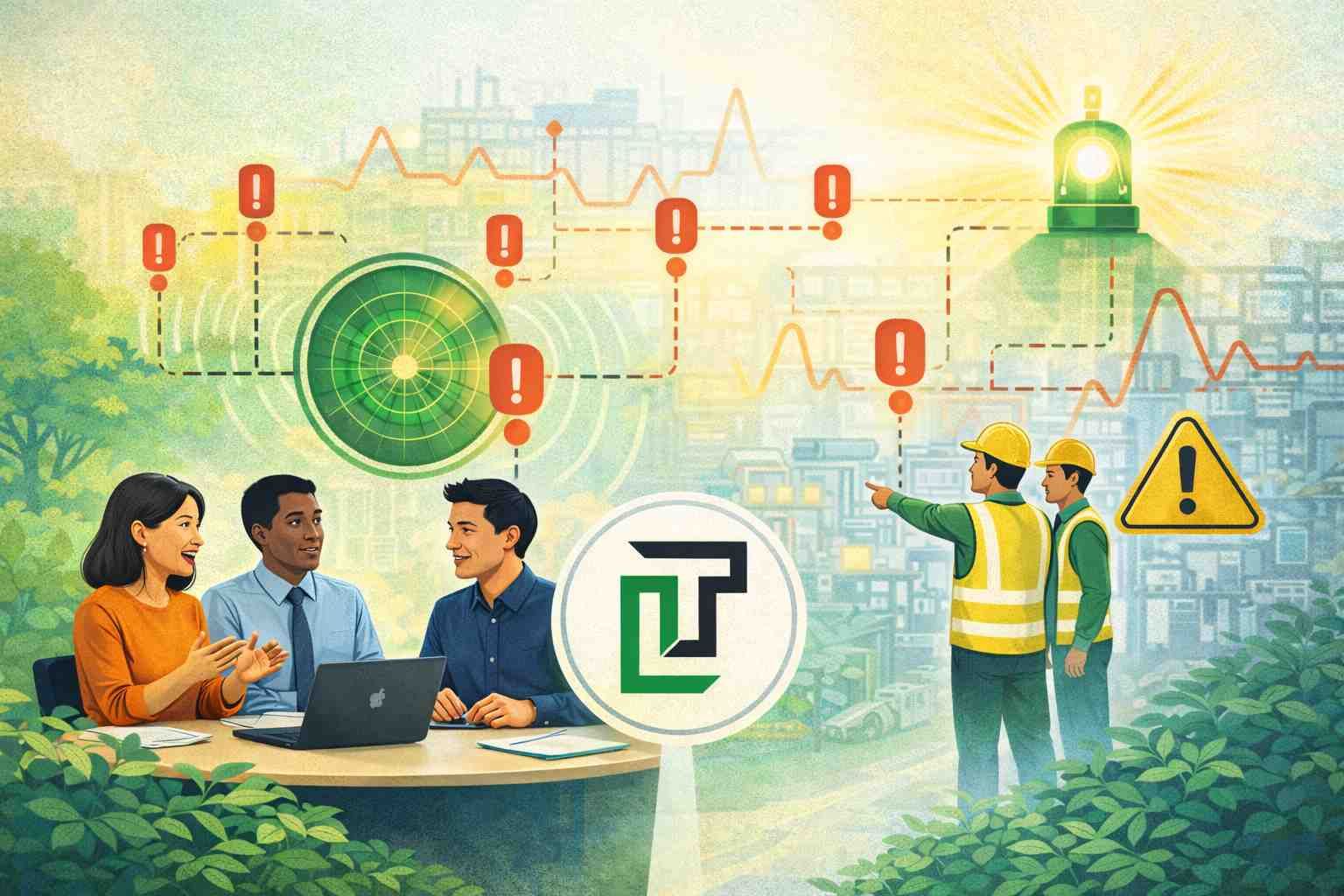
How Learning Teams Support Proactive Risk Awareness
Serious operational failures rarely arrive without warning. They are almost always preceded by a series of smaller signals, informal workarounds, recurring equipment behaviours, coordination patterns that consistently produce gaps, and procedural limitations that experienced workers have learned to manage quietly. These signals exist in the operational environment long before any threshold gets crossed.
Most organisations never see them until something goes wrong.
The challenge of proactive risk awareness is not finding new monitoring tools or tightening compliance requirements. It is building the conditions for operational signals to surface from the people who encounter them every day, in a form that leadership can act on while there is still time to change what is producing them. That is exactly what structured operational learning creates.
Risk Builds Gradually Before It Announces Itself
The pattern is consistent across industries and incident types. A maintenance crew learns to manage a piece of equipment through an informal sequence not mentioned in any procedure, because the formal start-up process consistently produces a fault under certain conditions. Over months, the informal sequence becomes standard practice on that shift. New starters learn it from experienced colleagues rather than from any written document. The system continues to function, but on a foundation that no formal record reflects.
Then conditions change. A new team member who has not yet learned the informal sequence follows the formal procedure. The fault occurs under operational conditions where its consequences are more significant than they were during previous occurrences.
The investigation that follows identifies a procedure that was not followed. The corrective action addresses the deviation. Neither the investigation nor the corrective action addresses the fact that the formal procedure had been generating a fault signal for months before anyone formally recorded it.
Why Reactive Systems Consistently Miss What Matters Most
Reactive safety management produces a specific and persistent blind spot. It is oriented toward outcomes rather than conditions. Incident investigations explain what happened. Audit findings document deviations from procedure. Corrective actions address the behaviour most visibly connected to the event.
The conditions that made the event predictable the workarounds, the informal practices, the system pressures that experienced workers were managing daily receive far less attention. They are background rather than foreground in a system oriented toward specific outcomes.
There is also the reporting problem. In organisations where being connected to a safety issue carries consequences, workers make rational decisions about what to surface. Observations that reflect well on individual competence get shared. Observations that reveal informal practices, or that raise questions about whether a procedure fits operational reality, tend to stay within the team that developed them.
The organisation loses access to exactly the operational intelligence it needs to identify risk before it reaches a threshold. Safety documentation grows. Real risk conditions stay hidden.
Frontline Teams See Risk Signals That Reporting Misses
The people closest to the work develop a detailed understanding of where the system is under stress long before that stress produces a recordable event. An experienced operator knows which combination of equipment state and environmental condition makes a particular task genuinely difficult rather than merely time-consuming. A supervisor notices that a specific shift configuration reliably produces a communication gap that the rest of the team compensates for in ways that are not entirely reliable.
None of this surfaces through standard reporting channels. Reporting systems are built to record events that cross a threshold. The observations that matter for early risk identification exist below that threshold in the daily adaptations, the quiet management of system limitations, and the accumulated experience of workers who have been navigating the gap between procedure and operational reality for months or years.
Accessing this knowledge requires something different from a reporting system. It requires a structured setting where workers can describe operational reality directly, without the filtering that formal reporting creates, to people who have the authority to act on what they hear.
Surfacing Weak Signals From Everyday Work
Operational Learning Team sessions are oriented toward exactly this kind of examination. The starting question is not what went wrong or whether the procedure was followed. It is how work actually happened under the conditions present, and what shaped the decisions made.
The Learn phase creates the context for weak signals to emerge. Participants describe what they directly experienced during a specific task or operational period. The facilitator builds a picture of how work actually ran, including the informal adjustments, the system pressures, the coordination patterns, and the points where documented procedure and operational reality diverged.
A worker describes increasing difficulty with a specific piece of equipment behaviour that has been developing gradually over several weeks. A supervisor explains that a particular handover consistently produces incomplete information transfer, and that the incoming team has developed an informal check to compensate. A technician describes a scenario where competing demands made the safer option impractical under the time constraint present on that shift.
These are operational risk signals. Individually, they may seem manageable. In the context of a structured session, with a senior sponsor present who has authority to act, they become the material for improvement decisions made while the conditions producing them are still present and addressable.
The Soak phase that follows gives participants time to reflect on what the initial session surfaced. Connections that were not visible in the room frequently emerge during this period. An observation one participant made about equipment behaviour connects to a pattern another participant recognises from a different operational context. The signal becomes clearer through the overnight reflection that the Soak phase provides before the Improve and Action phase converts that understanding into decisions.
Patterns Across Sessions Reveal What Individual Signals Cannot
A single operational signal from a single session at a single site may look like a local and manageable issue. The same signal appearing across multiple sessions, from different teams at different locations over different time periods, is telling the organisation something quite different.
This is where Learning Teams Software changes the quality of risk intelligence available at the organisational level. Session insights are captured centrally through Centralised Organisational Learning rather than remaining in a local session document or a facilitator's notes. The AI-powered analysis within the platform identifies recurring themes across sessions and makes those patterns visible to leadership.
A coordination gap described by a team at one facility connects to similar observations from two other teams at different sites working with comparable equipment and shift structures. An informal practice that one team developed to manage a procedural limitation appears in three other sessions from teams describing the same limitation. The pattern reveals a systemic condition rather than a localised adaptation.
The Global Learning Network extends this further. Anonymised learning themes from participating organisations worldwide are accessible through the platform, giving teams access to operational risk intelligence from environments facing comparable challenges.
This aggregation capability is what allows operational learning to function as a genuine early warning system rather than as a collection of individual session outputs.
What Static Risk Registers Cannot Track
Most formal risk management tools operate from a fixed picture of risk. A register is created, hazards are identified, controls are documented, and the register is reviewed periodically.
This approach works reasonably well for known, stable risks in predictable operational environments. It struggles considerably in complex environments where risk is dynamic, where the conditions that make certain outcomes more or less likely shift as equipment ages, operational demands change, team composition evolves, and informal practices develop in response to gaps between procedure and practice.
Static documentation cannot track these shifts. A risk register that was accurate when it was written may be significantly incomplete three months later without anyone recognising the misfit, because the register was not built to detect its own obsolescence.
Operational learning provides the dynamic understanding that static tools cannot. Each session examines current conditions rather than documented assumptions about conditions. Patterns that emerge across sessions reflect how risk is developing now rather than how it was categorised when the last formal review was completed.
Learning Teams Software supports this by maintaining a continuously updated picture of operational risk across the organisation, one that reflects what workers are actually experiencing rather than what controls were designed to address when the original risk assessment was conducted.
Conclusion
Risk signals exist in every complex operational environment, in the adaptations workers make, the informal practices that develop around procedural gaps, and the quiet management of system limitations that experienced teams learn through direct operational experience. These signals are visible to the people doing the work long before they cross any formal threshold.
Proactive risk awareness requires a structured mechanism for drawing those signals out and connecting them at the organisational level while there is still time to act on them. Operational Learning Teams provide that mechanism. Learning Teams Software ensures the insights that surface in individual sessions connect across teams, locations, and time making systemic risk conditions visible rather than leaving them as a collection of apparently separate local observations.
FAQ’s
How do Operational Learning Teams help identify risk before incidents occur?
Sessions examine how work actually runs under current conditions rather than investigating events after they occur. Frontline workers describe the informal adaptations, equipment behaviours, and coordination patterns that reveal where systems are under stress. These risk signals surface in sessions before they cross the threshold that triggers formal reporting, allowing organisations to address conditions while they are still addressable.
Why do weak risk signals stay invisible in traditional safety systems?
Traditional safety reporting is built around thresholds. It captures events that meet reportable criteria. The observations that matter most for early risk identification exist below those thresholds, in the daily adaptations and informal practices experienced workers use to manage system limitations. Formal channels were not designed to carry this information upward, and the individual cost of raising certain observations in blame-oriented systems means workers make rational decisions to keep them within the team.
How does Learning Teams Software connect risk signals across a large organisation?
Session insights are captured centrally and analysed through AI-powered pattern recognition that identifies recurring themes across sessions and locations. A risk signal that appears in one session looks like a local issue. The same signal appearing across multiple sessions from different teams reveals a systemic condition.
Learning Doesn’t Stop Here
Browse our collection of articles on learning teams, operational insight, and improving work as it’s done.


