

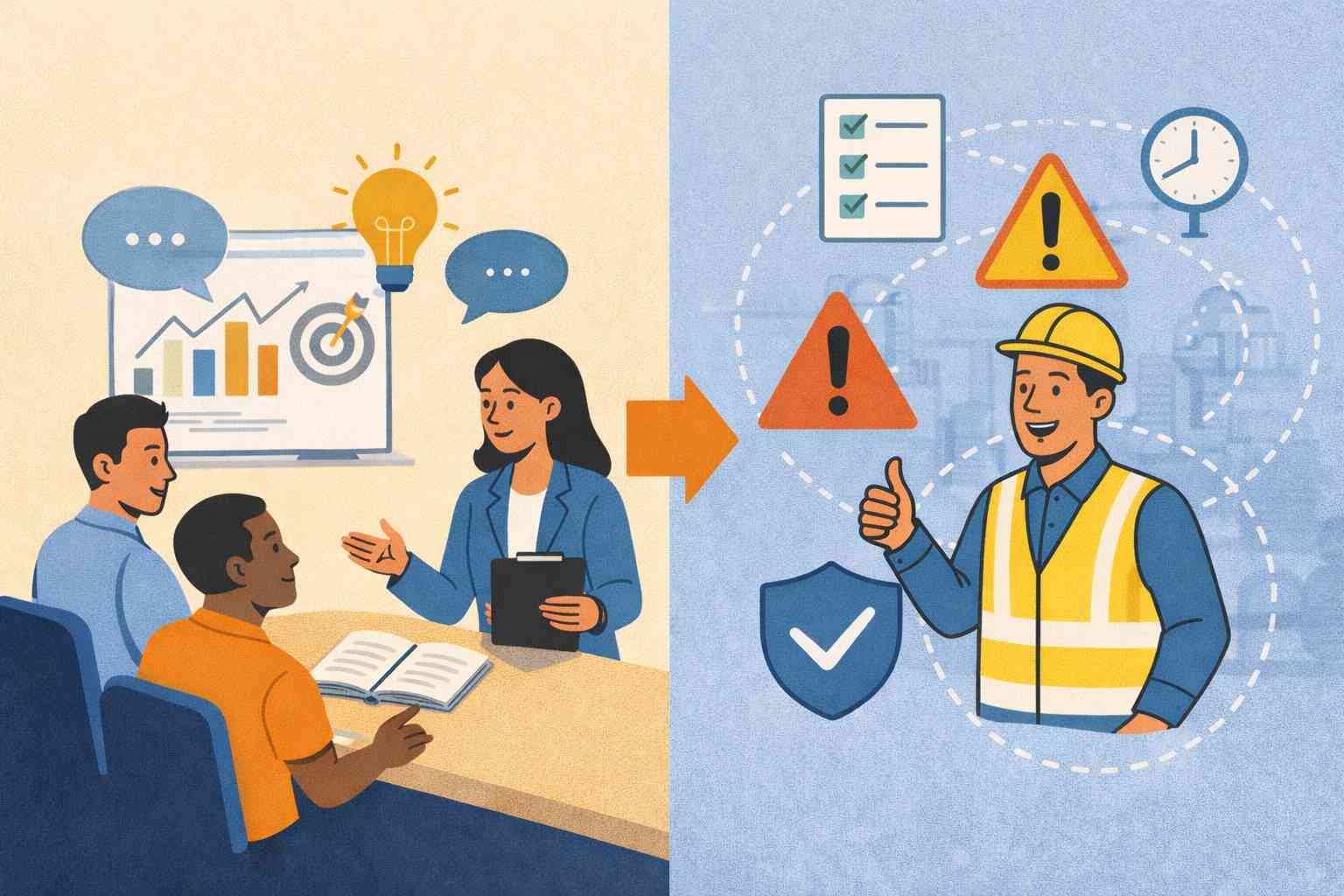
How Learning Teams Reduce Repeat Workforce Incidents
The same incident type appearing across different teams and different sites is not a coincidence. It is a pattern. And patterns have causes that are systemic rather than individual.
Most organisations dealing with repeat workforce incidents have done everything traditional safety management recommends. Procedures exist. Training has been delivered. Investigations have been completed and corrective actions assigned. The incidents keep happening anyway.
The reason is structural. Traditional safety responses fix people rather than examining the conditions that shaped what those people did. Until those conditions change, the same outcomes remain predictable regardless of how many times corrective action gets issued.
Repeat Incidents Signal That Learning Is Not Flowing Back
When the same incident type surfaces repeatedly, the organisation is telling itself something important. Learning is not completing its cycle. Insight generated after one event is not reaching the conditions that produced it.
This happens because most incident management is built around outcomes rather than around work. Investigations reconstruct what happened. Reports document findings. Corrective actions address the behaviour or decision most visibly connected to the event. The system conditions that shaped that behaviour, the time pressure, the equipment state, the procedural gap, the coordination breakdown, remain largely unchanged.
A month later, or a year later, a different worker encounters the same conditions. The outcome is often the same.
Addressing repeat workforce incidents means addressing the conditions that make those incidents predictable. That requires a different starting point than investigation. It requires a structured examination of how work actually runs before something goes wrong.
Why Compliance-Based Safety Is Reactive
Compliance-based safety operates from a specific assumption: if workers follow the procedure, incidents will not occur. When incidents do occur, the response is to reinforce compliance. More rules get added. Monitoring increases. Workers receive additional training on the procedure they reportedly did not follow.
This cycle feels productive. It produces visible activity. But it consistently fails to address what experienced frontline workers already know: that many procedures describe an idealised version of work that real operational conditions do not accommodate.
A worker who skips a step in a procedure is not necessarily being careless. They may be managing a time constraint, working around equipment behaviour that the procedure does not acknowledge, or following an informal practice that the whole shift uses because the formal procedure creates a different problem. Reinforcing compliance with that procedure does not address any of those conditions. It adds another instruction on top of them.
Compliance-based approaches also create a specific kind of silence. When workers know that being connected to a deviation carries consequences, they report what the system expects to hear. The informal practices, the adaptations, the workarounds that keep operations running but that diverge from documented procedure, stay hidden. The organisation loses access to exactly the information it needs to understand why certain outcomes keep occurring.
Learning Teams Create the Conditions for Honest Operational Insight
Operational Learning Team sessions are structured differently from investigations, audits, or standard safety briefings. The starting question is not what went wrong or who deviated from procedure. It is how work actually happened, under the conditions that were present, and what shaped the decisions that were made.
That distinction matters enormously for the kind of information that surfaces. When workers know a session is not a search for someone to blame, they describe operational reality rather than a sanitised version of it. They talk about the informal practices their team relies on. They describe the conditions that make certain tasks harder than the procedure suggests. They surface the small signals they have been noticing that have not yet triggered any formal report.
This is operational insight that no investigation report contains, because investigations start after something has gone wrong and are oriented toward explaining an outcome. Learning Teams start from normal work and are oriented toward understanding how work functions across its full range, including the successful outcomes and the near-outcomes that never reached a reporting threshold.
A senior sponsor with genuine decision-making authority is present in every session. This is not incidental. It means that what surfaces in the conversation can be acted on immediately rather than waiting for a separate approval cycle that may or may not produce change.
How Learning Teams Reveal What Investigations Miss
Consider a scenario that is common in high-risk operational environments. An incident occurs involving a handover process. An investigation identifies that information was not passed correctly between shifts. The corrective action is a revised handover checklist and a briefing to both teams.
Six months later, a similar incident occurred at the same site.
The investigation addressed the documented behaviour: incomplete information transfer. It did not examine why the handover process consistently produced incomplete information transfer. It did not ask what the incoming shift was actually doing with the information they received, or what time pressure shaped the departing shift's decision about how much detail to include.
An Operational Learning Team session examining that handover process would surface all of this. Participants from both shifts describe what the handover actually looks like in practice. They explain which parts of the formal process work, which parts get compressed under time pressure, and what informal signals the incoming team uses to fill the gaps the formal process leaves. The picture that emerges is of a system design that creates the conditions for information loss, not a workforce that cannot follow a checklist.
The improvement that follows addresses the system. The incident becomes significantly less likely to recur because the condition producing it has been changed.
System Design Changes Break the Repeat Incident Cycle
The repeat incident cycle breaks when improvement targets conditions rather than individuals. This is a straightforward principle that is consistently difficult to apply without a mechanism for examining what the conditions actually are.
Training tells workers what they should do. It does not change the conditions in which they are doing it. Disciplinary measures address the individual most visibly connected to an outcome. They do not address what made that outcome predictable in the first place. Revised procedures document a new official version of the work. They do not surface whether the new version accommodates the operational reality that made the old version impractical.
Operational Learning Teams examine operational conditions directly. Participants describe time pressures, equipment behaviours, coordination gaps, and procedural limitations that shape everyday decisions. This examination points toward specific system changes: adjustments to how work is sequenced, how handovers are structured, how equipment is maintained, how competing priorities get managed when they arrive simultaneously.
These are changes that reduce incident likelihood rather than changes that add compliance overhead on top of conditions that remain unchanged. That is the distinction between improvement that holds and improvement that produces activity without reducing risk.
How Learning Teams Software Connects Insights
A single Operational Learning Team session at a single site generates genuine operational insight. The greater value comes when those insights connect across sessions, teams, and locations over time.
In large organisations, the same system condition often produces similar incidents across multiple sites without anyone recognising the pattern. Each site investigates its own event. Each produces its own corrective action. The systemic condition that links them stays invisible because there is no mechanism connecting the separate examinations.
Learning Teams System captures session insights centrally and makes them searchable across the organisation. When the same theme surfaces repeatedly across different teams and locations, it becomes visible as a pattern rather than remaining hidden as a collection of apparently separate events.
The AI-powered analysis within the platform identifies recurring themes across sessions. A coordination gap that appeared in three separate sessions at different facilities shows up as a pattern rather than as three local problems. Leadership can address it at the system level rather than responding to each site in isolation.
The Global Learning Network extends this further, making anonymised learning themes from participating organisations worldwide accessible through the platform. Operational learning from comparable environments becomes available rather than having to be generated from scratch each time a similar challenge appears.
Conclusion
Repeat workforce incidents are not a sign that workers lack care or commitment. They are a sign that the conditions producing those incidents have not been examined closely enough or changed effectively enough to make recurrence less likely.
Learning Teams provide the mechanism for that examination. By creating structured, blame-free conversations about how work actually happens, they surface the system conditions that formal reporting misses. By connecting those conversations through Learning Teams Software, they make patterns visible across teams, sites, and time periods.
The organisations that reduce their repeat incident rates most durably are the ones that shift from asking who made a mistake to asking what in the system made that mistake predictable. Learning Teams are built around that question.
FAQ’s
How do Learning Teams reduce repeat workforce incidents?
By examining the system conditions that make certain incident types predictable, rather than focusing on the individuals involved in specific events. Operational Learning Team sessions surface what formal investigation misses: the time pressures, procedural gaps, equipment behaviours, and coordination patterns that shape decisions before anything goes wrong.
Why do repeat incidents persist even after investigations and corrective actions?
Because most investigations are oriented toward explaining an outcome rather than understanding the conditions that made it predictable. Corrective actions typically address the behaviour most visibly connected to the event. The system conditions that shaped that behaviour remain largely unchanged, making similar outcomes likely when the next worker encounters the same conditions.
How does Learning Teams Software support incident reduction across multiple sites?
Session insights are captured centrally and connected across teams, locations, and time periods. Recurring themes become visible as patterns rather than remaining hidden as separate local events. The AI-powered analysis within the platform identifies those patterns, allowing leadership to address systemic conditions at an organisational level rather than responding to each site's incidents in isolation.
Learning Doesn’t Stop Here
Browse our collection of articles on learning teams, operational insight, and improving work as it’s done.


