

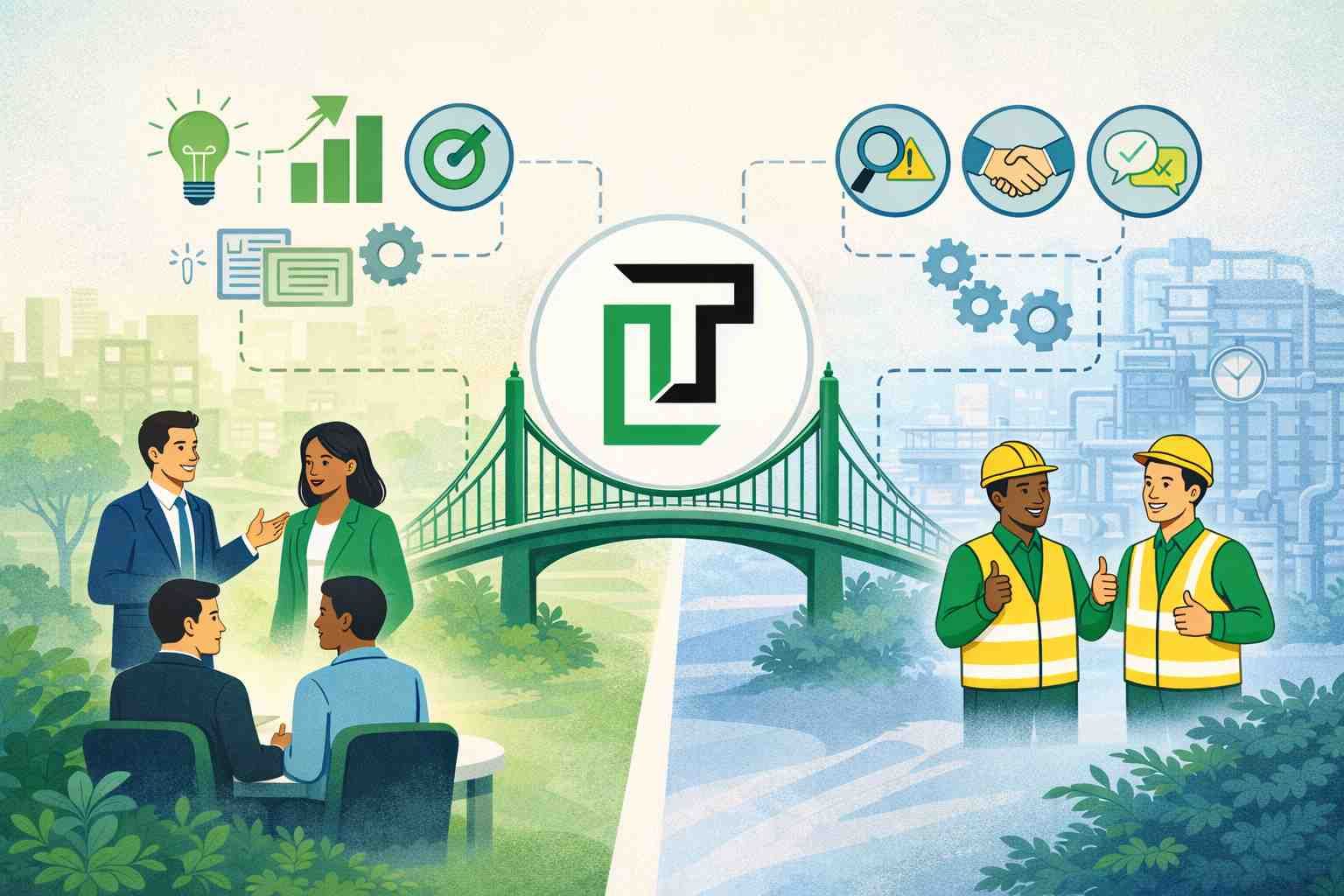
How Learning Teams Bridge Between Leadership & Frontline Work
In every organisation, two separate understandings of how work operates coexist without fully meeting. Leadership holds the strategic picture: the targets, the reports, the aggregated metrics, the decisions about resource allocation and process design. Frontline workers hold the operational picture: how work actually runs under real conditions, which procedures get navigated around and why, where coordination consistently breaks down, and what keeps systems functional despite the gap between documented process and operational reality.
Both pictures are real. Neither is complete on its own. And in most organisations, there is no reliable mechanism for the two to meet and correct each other.
This is the gap Learning Teams are built to bridge. Not through better communication, messaging or improved reporting tools, but through structured operational learning that makes frontline knowledge accessible to leadership decisions and leadership intent meaningful to frontline teams.
Most Organisational Communication Flows in One Direction Only
Leadership communication is primarily downward. Policies get issued. Targets get communicated. Training programmes get delivered. Safety briefings get held. All of this information movement goes from leadership toward the frontline.
The reverse channel is far narrower.
Most formal reporting systems capture events and exceptions: incidents that crossed a threshold, deviations from procedure, and performance metrics that fell outside an expected range. The information that travels upward through these channels is the official version of what happened, shaped by what reporting systems are built to receive.
What does not travel upward is the operational texture of daily work. Informal coordination practices were developed by two departments because the formal handover process consistently leaves a gap. Equipment behaviour that experienced operators manage through an informal warm-up sequence not mentioned in any procedure. Time pressure that makes a particular procedure impractical on certain shifts and results in a consistent workaround nobody has formally acknowledged.
This knowledge is not absent from the organisation. The people closest to the work hold it. It simply has no reliable channel through which it can reach the people making decisions about how work should be designed and managed.
Why Decisions Made at Distance Miss Operational Reality
The decisions that shape how frontline work operates are made by people whose primary information sources are reports, metrics, and official versions of operational processes. These sources are accurate in what they measure. They are consistently incomplete in what they miss.
A redesigned procedure introduced without knowledge of the informal practice it disrupts can create new problems faster than it solves the original ones. Resource allocation decisions made from aggregate throughput data can create workload pressures that experienced workers manage through adaptations, compounding existing risk. Safety interventions designed from audit findings address the deviation the audit found rather than the operational condition that was generating it.
None of these outcomes requires poor leadership. They require only that decisions be made from an incomplete picture of how work actually runs. When the information flowing to decision-makers has been filtered by formal reporting channels not designed to carry operational texture, decisions will consistently miss dimensions of operational reality that experienced frontline workers understand clearly.
The leadership-frontline gap is not primarily a communication problem. It is an information problem. Better messaging cannot close a gap that exists because the relevant information is not reaching the people who need it.
Learning Teams Create a Channel Formal Systems Cannot
Operational Learning Team sessions create the specific mechanism that formal reporting systems cannot: a structured context where frontline workers describe operational reality directly to people with the authority to act on what they hear.
The design of the session is what makes this possible. The Learn phase brings together no more than eight frontline workers, supervisors, and a senior sponsor. The facilitator is not guiding the conversation toward a predetermined explanation. The session examines how a specific task, activity, or operational topic actually unfolds in practice. Participants describe their direct experience without the filtering that formal reporting creates.
A worker explains that a particular procedure requires two people to complete safely but is routinely assigned to one because the scheduling system does not flag the discrepancy. A supervisor describes the informal communication pattern their team developed to manage the gap the formal handover process consistently leaves. An experienced technician describes the informal checks indicating whether a piece of equipment is ready for full operation, checks developed through experience that no document captures.
This is operational knowledge surfacing directly to the person in the room with authority to act on it. The senior sponsor's presence is not ceremonial. It means that what workers describe has an immediate pathway to decisions rather than entering a reporting system where it may be summarised, filtered, or deferred.
How Operational Learning Sessions Change What Leadership Knows
Leadership's access to accurate operational information changes what decisions are possible. This is the most direct mechanism through which Learning Teams bridge the gap.
A senior leader who participates in an Operational Learning Team session examining a specific process comes away with a qualitatively different understanding than any report has provided. They hear experienced workers describe what the process actually requires under real conditions. They understand which design assumptions do not hold in practice. They recognise the informal practices that developed to fill the gaps those assumptions created.
This understanding is not anecdotal. It is grounded in direct operational experience described by the people managing it every day. And it is considerably more useful for decisions about how to improve a process than the compliance rate on a related procedure.
Over time, as sessions cover different operational areas, the picture leadership holds of how the organisation's work actually functions becomes more accurate. Decisions about resource allocation, process redesign, and safety intervention become better calibrated to the operational conditions they are intended to address. The gap between intent and outcome narrows because intent is now forming from a more complete picture of the operational reality it is entering.
Shared Understanding Produces Better Decisions at Every Level
The two-way nature of the Learning Teams model changes not just what leadership knows but also what frontline workers understand about why things are designed the way they are.
When frontline workers participate in sessions where leadership is also present, they gain direct access to the reasoning behind decisions that have shaped their work environment. A policy that seemed arbitrary makes more sense when the safety concern driving it is explained by the person who made the decision. A resource constraint that created a difficult operational situation becomes clearer when the organisational pressures producing it are described in the session.
This mutual transparency is what shared understanding actually means in practice. It is not alignment achieved through better messaging. It is alignment achieved through genuine exchange of operational knowledge in both directions.
Trust develops from this exchange in a way that formal communication cannot produce. Workers who see their descriptions of operational reality lead to system changes rather than individual scrutiny share more honestly in subsequent sessions. Leaders who hear directly from frontline workers about the conditions shaping operational outcomes develop a more accurate and more respectful understanding of the complexity those workers navigate daily. The two-way learning loop this creates is qualitatively different from anything a reporting system or communication platform can replicate.
How Learning Teams Software Sustains the Connection Over Time
A single Operational Learning Team session creates a connection between leadership and frontline knowledge at a specific point in time. Sustaining that connection across a large organisation, across multiple sites, shifts, and operational areas, requires infrastructure that does not depend on individual effort to maintain.
Learning Teams Software provides that infrastructure. All session insights are captured centrally through Centralised Organisational Learning rather than existing only in the memory of participants or a local session document. The Orchestrated OLT Flow guides facilitators through the Learn, Soak and Improve and Action phases consistently, regardless of which facilitator runs the session or which site it happens at. Quality does not vary with the individual.
The AI-powered analysis within the platform connects observations across sessions. A theme surfacing at one facility appears alongside similar observations from other teams at other locations, making patterns visible at an organisational level rather than requiring manual comparison of separate reports.
The Share Learning Across the Business feature distributes session outcomes to leadership and operational teams immediately. The frontline insight that surfaced in a session reaches relevant decision-makers the same week rather than arriving through a reporting cycle that may take months.
Together, these capabilities mean the two-way connection Learning Teams sessions create between leadership and frontline knowledge becomes a consistent operational feature rather than something that exists only in the sessions where it is being actively built.
Conclusion
The gap between leadership intent and frontline reality is structural rather than personal. It exists because formal organisational systems were not designed to carry operational knowledge upward in the form that makes it genuinely useful for decisions.
Learning Teams address that structural gap directly. By creating conditions for frontline knowledge to reach leadership without being filtered or reframed, and for leadership intent to reach frontline teams with the operational context that makes it meaningful, they build the shared understanding that formal communication channels have never reliably produced.
Learning Teams platform sustains that understanding across the full scale of the organisation. The connection between leadership and frontline knowledge becomes a consistent operational capability rather than something that depends on a single committed individual to maintain.
FAQ’s
What makes the leadership-frontline gap difficult to close with standard communication tools?
Standard communication tools are built for one-way information flow, primarily from leadership toward the frontline. They carry decisions, policies, and updates effectively. Bringing operational knowledge upward in a form genuinely useful for decisions requires a different structure, one that surfaces informal practices, procedural gaps, and system conditions that experienced frontline workers understand but that do not fit into formal reporting fields.
How do Operational Learning Team sessions build genuine shared understanding? Sessions bring both frontline workers and a senior sponsor into the same structured conversation about how real work unfolds. Frontline workers describe operational reality directly, without the filtering that formal reporting creates. The sponsor hears what procedures are actually encountered in practice and can act on what surfaces without a separate approval process.
How does Learning Teams Software connect operational insight across a large organisation?
Session insights are captured centrally and connected across teams, locations, and time through Centralised Organisational Learning and AI-powered analysis that identifies recurring themes across sessions. The two-way connection between leadership and frontline knowledge persists across sites and shifts without depending on any single person's effort to maintain it.
Learning Doesn’t Stop Here
Browse our collection of articles on learning teams, operational insight, and improving work as it’s done.


