

How a Learning Team Platform Reduces Risk Through Learning
Think about the last time something went wrong in your organisation. There were signs even before that moment, such as a recurring equipment issue that no one addressed and a communication gap between the two teams. A workaround that worked most of the time until it failed.
Most organisations fail to catch these signs. Their safety systems are designed to react after failure, not to learn before it happens. A learning team platform changes that approach by reducing these risks and turning everyday work into organisational learning, not just accidents.
Learn how our learning team platform continuously learns from real operations, develops true risk awareness, and handles problems before they become accidents.
Why reactive risk management falls short
Safety investigations are useful. When something goes wrong, it is important to understand why it happened. But accident investigations always begin after the fact. They record what happened, but rarely show what factors have been building up over the weeks or months leading up to it.
Real operational risk is present in everyday operations. It appears when operators make small changes to handle equipment in unexpected situations. It accumulates in routines that teams create because formal procedures do not fully reflect field conditions. It grows in communication patterns that change under time pressure.
By the time this all shows up in a report, the risk has already increased significantly.
Organisations that rely solely on learning after accidents are always one step behind. They improve after failures, not before them. This limits real progress in safety, no matter how good the investigation process is.
What a Learning Team platform does differently
A learning team platform brings the learning process to the forefront. Instead of teams waiting for failures to reveal system weaknesses, they look at how work is actually being done at the moment.
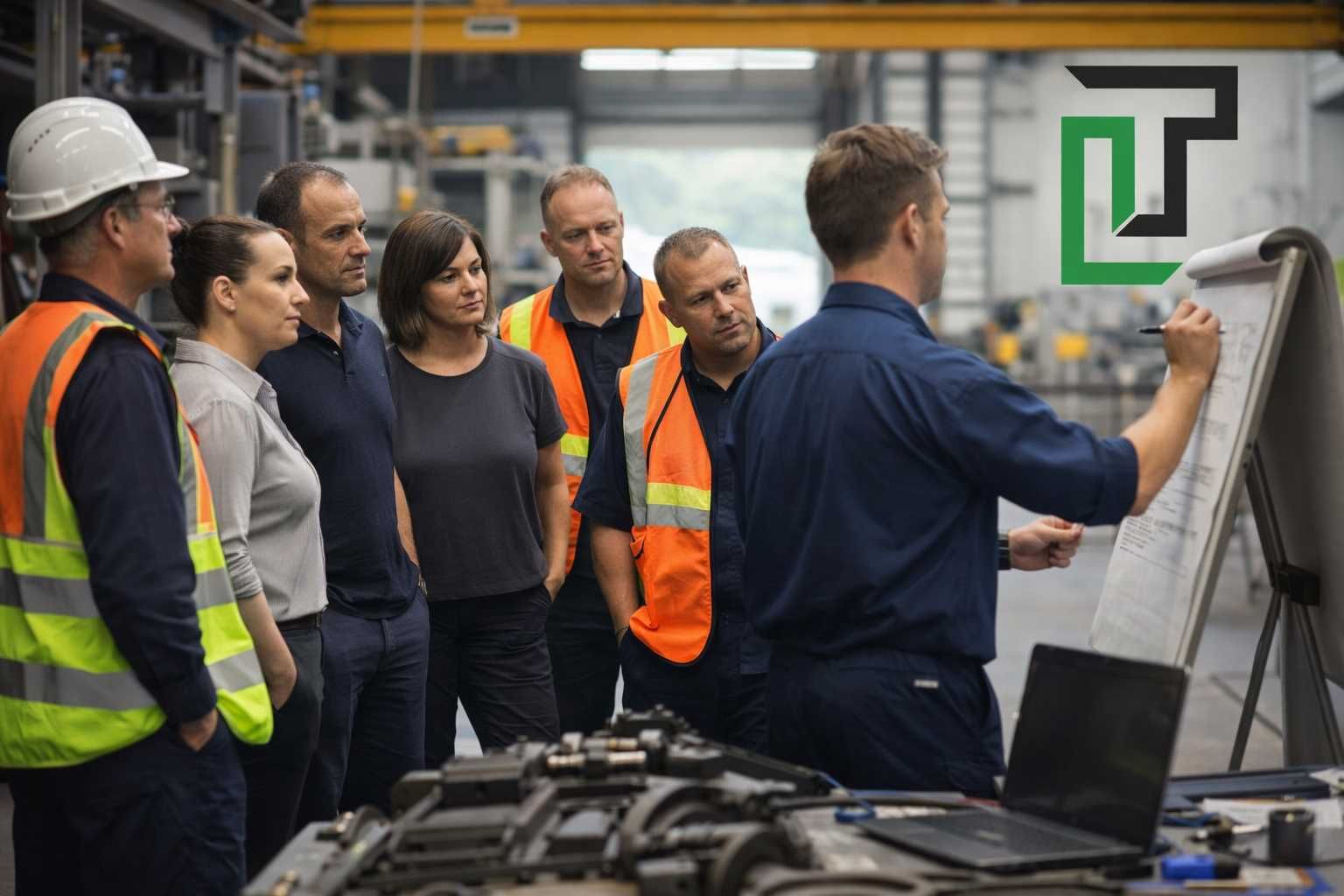
Operational learning teams bring together small groups of up to eight people at a time to reflect on recent work experiences. These sessions are not debriefings after an accident. They focus on normal day-to-day operations: the situations people worked in, the decisions they made, and the moments when the work felt more than necessary.
These sessions follow a structured three-phase process. In the “Learn” phase, participants describe what they actually experienced, not what the process should have been. During this phase, a sponsor is present who has real decision-making authority, so that the insights gained are not limited to documenting recommendations but are also acted upon.
The initial session is followed by the “Soak” phase, in which participants are given time to reflect on what has been discussed. This overnight break is intentional. Observations that seem minor in the room often turn into larger issues over time. The group reconvenes the next day in the “Improve and Action” phase to determine what changes the organisation should make.
This structure ensures that learning is real, not just a formality. It creates conditions where true operational risk awareness is built, not just box-filling compliance.
How Early Risk Signals Become Visible
Risk rarely arises from a single clear point of failure. It is actually the accumulation of small, discrete observations across teams and departments.
One team reports that a particular handover process often results in the incoming team starting work without full preparation. Another team reports that a particular piece of equipment is responding more slowly than its specified specifications. A supervisor notes that a critical decision is always delayed when two specific managers are not available at the same time.
None of these observations alone triggers an incident report. Each seems to be a localised problem.
But within the Learning Team platform, it all ties together. Learning Teams software captures what participants say during sessions and makes those insights searchable across teams and locations. When the same topic comes up repeatedly across sessions, it’s not a one-time complaint but a pattern. That’s where organisational risk really lies.
Catching these patterns before they’ve fully coalesced is the practical application of learning-based risk reduction. Organisations that recognise these patterns early on spend less time managing crises and focus instead on improving systems before something breaks.
Operational Risk Awareness Builds Over Time
When organisations consistently use operational learning teams, they experience a clear shift. People begin to see the work around them differently.
Frontline workers now begin to bring up observations they previously dismissed as too trivial. Supervisors are better able to identify which operational pressures truly deserve attention. Leaders get a true picture of everyday work situations, not a filtered version based on what people think leadership wants to hear.
This awareness grows stronger over time. Each session builds on the previous sessions, and the organisation gradually develops a clearer and more honest understanding of where the real weaknesses in its system lie.
A global learning network extends this process even further. Insights gained by one team are shared with teams in other locations, allowing organisations to learn collectively rather than in isolation. Lessons learned in one location are not limited to that location.
This is how safety based on learning at scale works. Safety is no longer just a set of rules imposed from above, but a process in which the entire organisation plays an active role.
Turning Learning Into Sustained Risk Improvement
Operational learning teams software is not about gaining insight or coming up with a one-time procedural solution. The goal is to fundamentally change how organisations understand and manage risk over time.
Each session provides new information about current operational conditions. This information forms the basis for changes. Subsequent sessions look at whether those changes have been effective, what new conditions have emerged, and what more can be learned. Organisations that maintain this continuity build operational resilience that truly reduces the likelihood of major losses or critical failures.
Sponsors play a critical role in this continuum. Because each session involves someone with real decision-making authority, actions move forward immediately, rather than waiting for a separate approval process. This way, learning is directly tied to change.
For organisations that truly want to move beyond reactive safety, the Learning Team Platform provides a structured framework that makes continuous risk improvement an achievable reality, not just a wish.
Conclusion
Risk grows silently. It is born from the gap between how things should be done and how they actually get done every day. By the time this gap becomes an accident, the opportunity to prevent it has passed.
Operational learning teams reduce this gap. Through learning team platforms, organisations create awareness that identifies risks at an early stage and connects observations from different teams, so that improvement becomes a continuous process, not just a reaction.
Organisations that invest in this approach don’t wait for the next accident to tell them where they fell short. They learn continuously from their daily work and, as a result, establish safer operations.
FAQ’s
Q1: How does a Learning Team platform help prevent incidents before they happen?
It establishes a system in which teams hold regular sessions where they review real-world work situations, rather than waiting for a failure to trigger an analysis. Recurring observations are saved and linked across teams, so that risk patterns emerge when they can be acted upon.
Q2: Who takes part in an Operational Learning Team session?
Each session involves a small group of up to eight people, drawn from the teams closest to the work in question, accompanied by a sponsor with decision-making authority, so that the results are directly implemented and do not have to wait for approval.
Q3: How is a Learning Team session different from a standard incident investigation?
An incident investigation begins when something goes wrong. A learning team session begins with everyday work and looks at how operations actually work under normal circumstances. This means that organisations learn not only from failures but also from stable operations.
Learning Doesn’t Stop Here
Browse our collection of articles on learning teams, operational insight, and improving work as it’s done.


